
Can You Help Me Create a Maintenance Plan After Organization?

Yes — and creating a maintenance plan is one of the most important things we do at the end of every organizing engagement. Getting a home organized is the beginning of the work, not the end of it. A home without a maintenance strategy drifts back towards its previous state within weeks or months, because the organizing addressed the symptoms but not the daily habits that will keep the systems working.
This guide explains what a professional organizing maintenance plan includes, the long-term support options available, and the simple daily and seasonal habits that make organized spaces stay organized without requiring another full session every few months.
WHY MAINTENANCE MATTERS: The most common reason organized spaces revert is not a failure of willpower or discipline. It is a failure of system design — the organizing system was not designed with maintenance in mind. A well-designed system is easy to maintain because returning items to their places requires less effort than not doing so. When maintenance feels like a chore, the system needs adjustment. When it feels automatic, the system is working.
What a Maintenance Plan Includes
A maintenance plan is not a cleaning schedule. It is a set of habits, checkpoints, and support structures that protect the organizing work already done. At Home to Home Services, every organizing engagement ends with a maintenance plan tailored to the client’s household, their daily routines, and the specific systems we installed. A standard maintenance plan covers four layers:
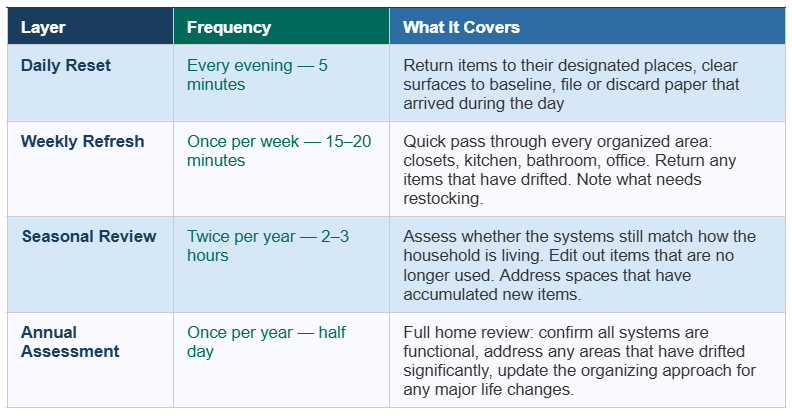
THE FIVE-MINUTE RESET: The daily reset is the single most important maintenance habit and the one that prevents every other layer from becoming overwhelming. Five minutes at the end of the day — consistent, non-negotiable, before the household settles for the evening — is what keeps spaces organized. It is not about perfection. It is about returning the home to baseline so the next day starts from a functional position rather than the previous day’s drift.
Long-Term Support Options
Not every household needs ongoing professional support to maintain their organizing systems — but many benefit from it, particularly during life transitions, high-demand periods, or when the household’s circumstances change significantly. Home to Home Services offers several support structures for long-term organizing maintenance:
Quarterly Check-in Sessions
A focused 2-3 hour session four times per year to review every organized area, address drift, edit out items that are no longer serving the household, and refresh any systems that need adjustment. This is the most popular ongoing support structure for clients who want professional accountability without frequent sessions.
Best for: households that maintain well day-to-day but benefit from a professional reset and review four times per year.
Seasonal Transition Sessions
Twice-yearly sessions timed to spring and fall that address the specific organizing needs of each seasonal transition: rotating wardrobes, managing holiday item storage, addressing garage and outdoor storage changes, and preparing for the seasonal shift in how the household uses its spaces.
Best for: households with significant seasonal storage needs or wardrobes that require active rotational management.
Monthly Maintenance Sessions
A shorter monthly session — typically 1-2 hours — for households that want consistent professional support to maintain their systems. Particularly valuable for households with high turnover of items (families with children, active social lives, frequent purchases) or for clients managing cognitive or physical limitations where the daily reset requires professional facilitation.
Best for: households that benefit from consistent professional presence, clients with limitations, or families in high-volume environments.
On-Demand Sessions
No scheduled cadence — clients contact us when they notice drift, when a specific area has gotten out of control, or when a life event (a new baby, a family member moving in, a job change has disrupted existing systems. These sessions address the specific need without a standing commitment.
Best for: self-sufficient households that occasionally need professional reinforcement after a disruptive event.
The Maintenance Habits That Work Without Professional Help
Most households can maintain their organizing systems independently with the right habits in place. Here are the ones that consistently make the biggest difference:
Daily (5 minutes)
Clear every visible surface to baseline before the household goes to bed. Kitchen counters. Coffee table. Bathroom counter. Every surface. This single habit prevents the accumulation that makes weekly maintenance feel overwhelming.
Handle paper immediately: action, file, or discard. Paper that sits on a surface becomes a pile within days and a crisis within weeks.
Return items to their designated places as you use them, not at the end of the day. The difference between 30 seconds now and 30 minutes later is the habit that separates maintained homes from ones that need constant resets.
Weekly (15-20 minutes)
Walk through every organized area and return anything that has drifted. This is not a deep clean — it is a quick pass to reset what the daily habit missed.
Address the inbox: any paper, mail, or document that arrived during the week that has not been processed.
Assess the kitchen: return pantry items to their zones, clear the refrigerator of anything past its use date, confirm the counter is at baseline.
Seasonally (2-3 hours, twice per year)
Rotate seasonal items: clothing, outdoor equipment, holiday storage. Only what is in season belongs in primary storage.
Conduct a room-by-room honest edit: identify items accumulated since the last seasonal review that are not being used. Donate or discard rather than storing.
Assess whether the organizing systems still match how the household is living. Life changes — a child’s interests shift, a work situation changes, a family member moves in or out. Systems should evolve with the household, not remain static.
THE ONE-IN-ONE-OUT RULE: The single most effective long-term maintenance habit for households that tend to accumulate: for every new item that enters the home, one item leaves. A new piece of clothing means one piece is donated. A new kitchen gadget means one leaves. This rule prevents the gradual re-accumulation that undoes organizing work over time. It is simple, clear, and sustainable in a way that periodic purges are not.
When to book a Maintenance Session
You do not need to wait until the home has reverted to its previous state to book a maintenance session. The right time to reach out is when:
A specific area has drifted noticeably and the weekly reset is not addressing it.
A significant life event has disrupted existing systems: a new baby, a child leaving for college, a remote work arrangement, a health change, a family member moving in.
The seasonal transition — spring or fall — has arrived and the wardrobe rotation, holiday storage, or seasonal organization needs professional facilitation.
You notice that maintaining the systems is starting to feel effortful rather than automatic — which usually means a system needs adjustment, not more discipline.
It has been more than six months since the original organizing session and you want a professional review before drift becomes significant.
FOR RICHMOND AND DC CLIENTS: Home to Home Services offers maintenance sessions and ongoing support packages for clients throughout Richmond, VA and the Washington, DC area, including Capitol Hill and surrounding neighborhoods. If you had an organizing session with us and are ready to set up a maintenance plan, contact us directly. If you are a new client whose previous organizer did not offer maintenance support, we welcome the conversation.
An organized home is not a static achievement. It is a dynamic state that requires the right systems, the right habits, and the right level of professional support for the household maintaining it. A maintenance plan is not an acknowledgment that the organizing did not work — it is the structure that makes sure it does.
Ready to set up your maintenance plan?
Home to Home Services creates custom maintenance plans and offers ongoing organizing support for clients throughout Richmond, VA and Washington, DC. Whether you need quarterly check-ins, seasonal transitions, or occasional on-demand sessions, we build the support structure that fits your household.
Contact us to today for a free consultation.
Call or text: 804-496-1767
About Home to Home Services
Home to Home Services is a full-service home transition company specializing in packing & unpacking, move management, home organizing, and design & space planning. We serve homeowners, families, and seniors throughout Richmond, VA, Washington, DC, and surrounding areas.
