
How Do I Organize My Closet Without Buying New Furniture

The most common mistake people make when organizing a closet is buying things before understanding the problem. A trip to The Container Store or a scroll through Amazon results in bins, dividers, and organizers that may or may not fit, may or may not suit the actual issue, and frequently end up adding to the clutter rather than solving it.
The good news: a genuinely well-organized closet does not require new furniture. It requires a clear process, a few inexpensive products in the right places, and a willingness to start with subtraction rather than addition. This guide covers the six steps that transform any closet — reach-in, walk-in, or somewhere in between — without spending more than $60.
WHO THIS GUIDE IS FOR: This guide applies to homeowners and renters in Richmond, Capitol Hill, Adams Morgan, Dupont Circle, and anywhere else where closets are smaller than the wardrobe trying to live in them. The principles are universal. The product suggestions are all under $20 individually and available at Target, Amazon, IKEA, and most home goods stores.
1 - Declutter First — Everything Else Depends on It
Before buying a single product or rearranging a single hanger, declutter. This is the step most people skip because it feels slow and unglamorous. It is also the step that determines whether everything that follows works. A closet with too much in it cannot be organized — it can only be rearranged.
Remove everything from the closet completely. Every item. This is non-negotiable — working around what is there means working around the problem.
Sort into 4 categories: keep, donate, season (store elsewhere), and discard. Be honest — if you have not worn it in a year and it does not bring you genuine joy when you hold it, it is a candidate for donation.
Return only what you are keeping and wearing. Everything else leaves.
For a reach-in closet, the target is 60-70% capacity after the declutter. For a walk-in, aim for clear floor space and visible access to every item.
THE FREE UPGRADE: Decluttering a closet is completely free and produces the single largest improvement in closet function of any step in this guide. A closet with less in it is easier to navigate, faster to get ready in, and simpler to maintain than any organized closet with too much in it.
2 - Use What You Already Have Differently
Before any purchase, assess what is already in the closet that can be used differently. Most closets contain unused capacity that is invisible because of how items are currently arranged.
Double hang where possible. If the current single rod leaves significant empty space below hanging clothes, add a second hanging rod below — a basic hanging rod extender costs $10-15 and doubles hanging capacity in that section.
Group by category, not by color. Hang all pants together, all tops together, all jackets together. This immediately reveals how much of each category you have and creates intuitive organization without any product.
Use the closet floor intentionally. Shoes in rows (not piled), a small basket for items awaiting repair, a bin for infrequently used bags. The floor is storage, not a landing zone.
Use the shelf above the rod. Most closets have a shelf above the hanging rod that is either unused or holds a disorganized pile. Folded items in neat stacks or bins on this shelf adds a full level of organized storage.
3 - Add Vertical Space with Shelf Dividers and Stackers
The most consistent source of wasted closet space is unused vertical height within existing shelves. Most closets have one shelf above the rod — and that shelf has 18-24 inches of empty air above it that holds nothing. Simple, inexpensive products address this without any installation.
Shelf dividers keep folded stacks from toppling into each other, allowing tighter, more efficient use of shelf width. A set of four runs $8-15.
Stackable shelf organizers create a second level on top of a flat shelf, turning one storage surface into two. Available in wire, acrylic, or wood versions at most home stores.
Clear stackable bins on upper shelves hold seasonal items, accessories, or rarely needed items in a visible, accessible format.
Shoe stacking risers let you store two rows of shoes in the space one row previously occupied.
SMALL SPACES NOTE: In Capitol Hill rowhouses, Adams Morgan apartments, and many DC and Richmond homes with reach-in closets rather than walk-ins, vertical space is the primary expansion opportunity. A reach-in closet that uses its full height — floor to ceiling — has significantly more usable space than one organized only at eye level.
4 - Upgrade Hangers — One of the Highest-ROI Closet Changes
This sounds trivial. It is not. Mismatched plastic hangers are bulky, inconsistent in thickness, and allow garments to slide and bunch together. Switching to a uniform set of slim velvet hangers is the single highest-return-per-dollar closet improvement available.
Slim velvet hangers are roughly half the thickness of standard plastic hangers. Replacing a rod of 30 plastic hangers with velvet hangers effectively creates space for 10-15 additional garments on the same rod.
The non-slip surface prevents clothes from falling and eliminates the bunching that makes everything hard to see and access.
A set of 50 slim velvet hangers costs $10-15. This is one of the most commonly recommended closet changes by professional organizers for exactly this reason: maximum impact, minimum cost.
Use matching cascading hanger clips for pants and scarves to keep them visible and accessible without separate storage.
5 - Add Over-the-Door and Back-of-Door Storage
The back of the closet door is the most consistently wasted surface in any closet. In a reach-in closet especially, this surface can hold a significant amount of storage without occupying any floor or shelf space.
An over-the-door shoe organizer holds 24-36 pairs of shoes in the space of the door panel — removing them entirely from the closet door.
Over-the-door hooks hold bags, belts, robes, and tomorrow’s outfit within easy reach.
Over-the-door accessory organizers with clear pockets hold jewelry, scarves, sunglasses, and small accessories in a visible, organized format.
Over-the-door organizers require no tools and no installation for standard door depths. They are completely reversible and move with you.
FOR DC APARTMENTS AND ROWHOUSES: In Capitol Hill, Dupont Circle, Columbia Heights, and other DC neighborhoods where closet space is consistently limited, over-the-door storage is one of the most valuable tools available. It adds storage capacity in a form factor that uses no floor space and requires no modification to the apartment or home.
6 - Store Seasonally — Only Keep Current-Season Items Accessible
A closet organized around all four seasons simultaneously is always going to feel crowded, even when it is not. The professional approach to any small or medium closet is seasonal rotation: only the current season’s items live in the primary closet.
Off-season clothing goes into under-bed storage bins, a spare closet, or a vacuum-sealed bag stored in a less accessible location.
The transition takes 30-45 minutes twice a year and immediately removes 30-50% of the closet’s volume, making the current-season items significantly more accessible.
Label storage bins by season and category so the transition next time takes minutes rather than decisions.
Accessories, shoes, and outerwear can often remain year-round — focus the rotation on clothing, which represents the largest volume.
THE RESULT: A closet that contains only what you are wearing right now — at 60-70% capacity, with uniform hangers, vertical space used, and the door back organized — feels and functions like a completely different closet. The investment in products to reach this outcome is typically $30-60. The investment in time is a single focused session of three to four hours.
Budget Summary: What it Costs to Do This Right
Here is a realistic budget for a complete closet transformation using the steps in this guide:
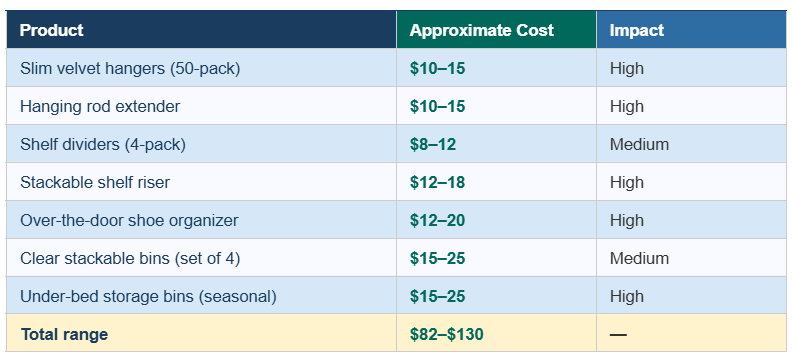
THE REAL INVESTMENT: The products in this guide total $82 - $130 for a complete closet overhaul. The time investment is a single focused session of 3-4 hours. The result is a closet that functions better than any you could buy pre-packaged for ten times the price — because it is designed around your actual wardrobe, your actual space, and your actual daily routine.
You do not need new furniture to organize your closet. You need a clear starting point, honest decisions about what stays, and a handful of inexpensive products that address the specific problems your closet has. Start with the declutter. The rest follows naturally.
Want a professional to handle it for you?
Home to Home Services provides professional closet and home organizing throughout Richmond, VA and the Washington, DC area including Capitol Hill, Northeast DC, and surrounding neighborhoods. We do the decluttering, the system design, and the full implementation — in a single session.
Contact us today to for a free consultation.
Call or text: 804-496-1767
About Home to Home Services
Home to Home Services is a full-service home transition company specializing in packing & unpacking, move management, home organizing, and design & space planning. We serve homeowners, families, and seniors throughout Richmond, VA, Washington, DC, and surrounding areas.
