
The Right Way to Label Moving Boxes (So Unpacking Doesn’t Take Weeks)

Most moving boxes get labeled the same way: a marker, the room name, and if the packer is feeling ambitious, a vague description of contents. “Kitchen stuff.” “Primary bedroom misc.” “Books — heavy.”
This system works just well enough to get boxes into approximately the right rooms — and not nearly well enough to support an efficient unpack. The result is what most people experience after a move: a home full of boxes that takes weeks to sort through because nothing was organized for unpacking, only for transport.
There is a better system. It takes about then minutes to set up before packing begins, costs under $5 in supplies, and cuts unpacking time in half. Here is exactly how it works.
Why Generic Mover Labeling Fails
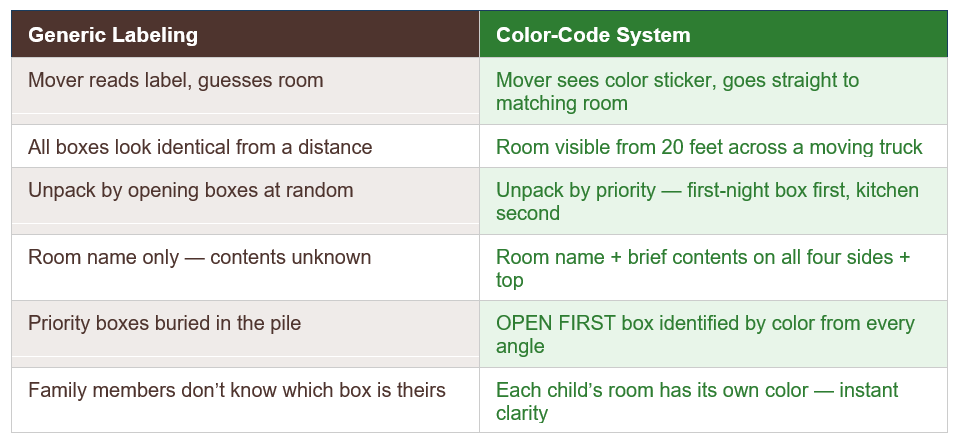
The standard marker-on-box approach has two fundamental problems:
It only tells you where a box goes — not what is in it. A box labeled “Kitchen” sitting in the kitchen still requires opening to find out whether it has the coffee maker or the holiday serving platters. On moving day, when you need the coffee maker immediately, this matters.
It gives movers no visual guidance. A mover carrying a box to a new home has to read the handwritten label, finding the matching room, and make a judgment call. When every box looks identical, boxes end up in wrong rooms, stacked against walls in the order they came off the truck rather than in any functional sequence.
The Color-Code System That Actually Works
The color-code labeling system assigns one colored 2×3 inch sticker to each room of the home. Every box packed for that room gets a large rectangular sticker on two diagonal corners so that the stickers are visible from every direction when placed on in the rooms. The corresponding color is marked at the door of each room in the new home before moving day.
When the truck arrives, movers do not need to read handwriting or ask questions. They see the color, walk to the matching door, and set down the box. Priority is visible from across the truck. The result is dramatically faster unloading and a new home where boxes are already sorted before a single one is opened.
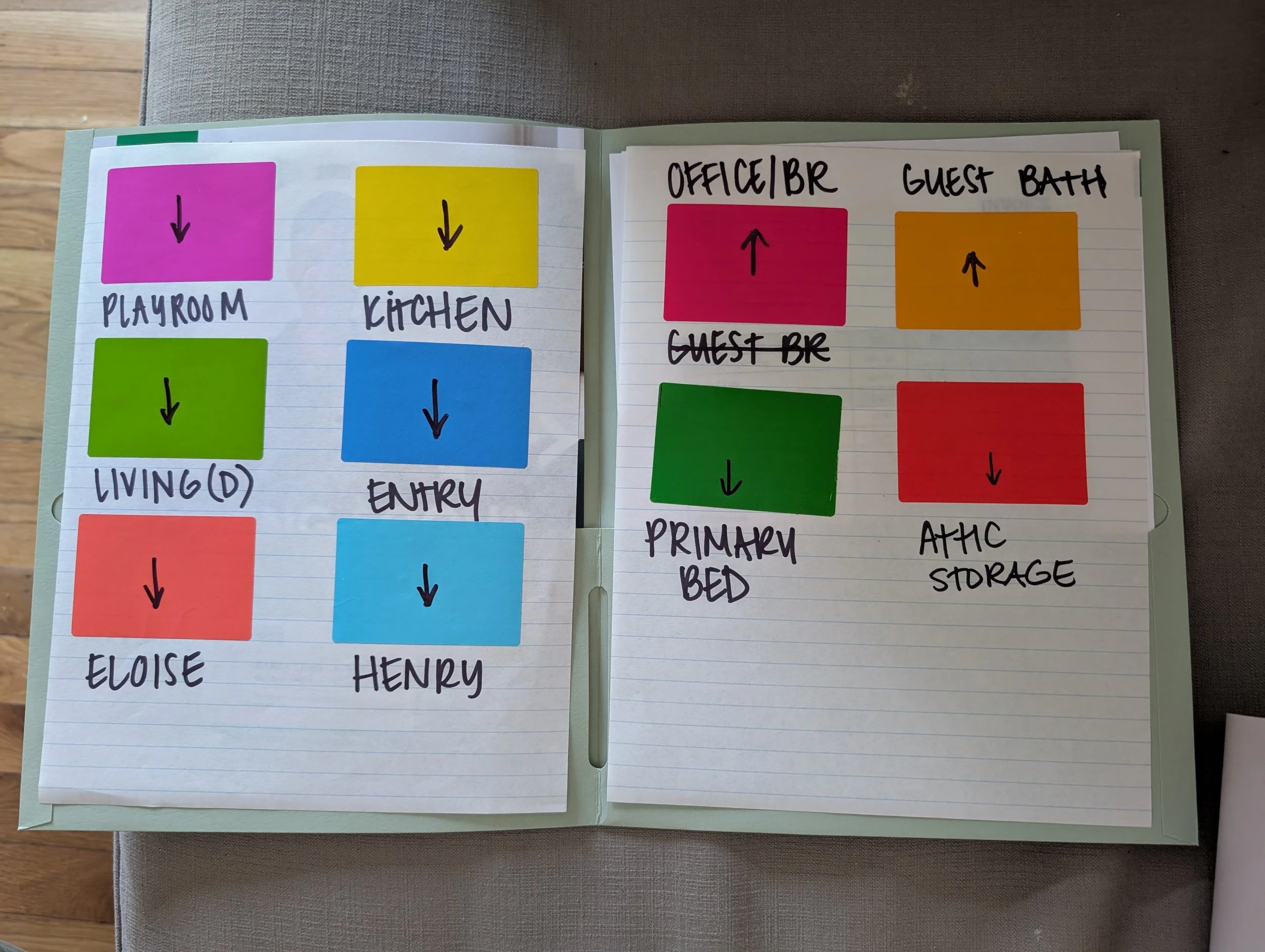
This is what the start of a well-organized move looks like. Before a single box is packed, every room gets its own color. Movers see the sticker, go straight to the right room, and never have to ask. No mystery boxes. No wrong-room piles. No guessing at the end of a 10-hour day.
We set this up at the start of every move we manage. It's one of the things clients remember most. 🏠
ADAPT THE SYSTEM TO YOUR HOME: The room-color assignments above are a starting framework. Adjust them to match your specific home — if you have two children’s rooms, assign each its own color. If you have a basement or a sunroom, add a color. The rule is one color per destination room, consistently applied to every box going there. The system only works when it is applied without exception.
How to Label Each Box — The Professional Standard
A colored 2×3 sticker tells movers where a box goes. The written label tells you what is in it when you are unpacking. Both are essential. Here is the professional labeling standard for every box:
TOP of box
TOP LOAD (if applicable) — this tells the movers that there’s a lamp or something super fragile placed towards the top of the box and not to stack anything on top of this box.
All 4 SIDES
When a rectangular colored sticker is centered on opposite corners of a box, the colored sticker is visible on all sides of the box. Do the same for Fragile stickers.
ONE SIDE only
To save time and cost, label one side, preferably the long side of a box, with a list of items the box contains.
The OPEN FIRST Box: The Most Important Box in the Move
Every household packing for a move should have one box — labeled, colored, and loaded last onto the truck so it comes off first — that contains everything a household needs in the first 12 hours of a new home. This is the OPEN FIRST box, and it gets a distinct color (hot pink or bright yellow) that nothing else uses.
What goes in the OPEN FIRST box:
Phone chargers and power strips for every member of the household
Medications taken daily — for every person
One set of bed linens per bed being slept in that night
Toilet paper — minimum one roll per bathroom
Hand soap and a small towel for every bathroom
Coffee maker, coffee, and two mugs — this is non-negotiable for most households
A change of clothes for every person sleeping in the new home that night
Children’s comfort items — a specific toy, a blanket, a stuffed animal
Paper plates, cups, and utensils for the first meal
A small toolkit: screwdriver, hammer, picture-hanging hardware, box cutter
Any document or items that cannot be replaced or that will be needed immediately
THE OPEN FIRST RULE: The OPEN FIRST box travels in the car with the family, not in the moving truck. It is the last thing loaded into the car and the first thing into the new home. If the truck is delayed, damaged, or inaccessible for any reason, the OPEN FIRST box means the household can function overnight. This is not a luxury — it is standard professional practice on every move we manage.
Set Up the New Home’s Color System Before the Truck Arrives
The color-code system only works if the new home is coded before moving day. Here is the setup that takes 15 minutes and makes unloading dramatically more efficient:
Print or write the room name and its assigned color on a piece of paper — one per room.
Place the colored sticker on each room sign and tape it to the door of each room at eye level. Movers arriving with boxes can see the color from the hallway before they reach the door.
Brief every mover on the system when they arrive: “Each box has a colored sticker. Match the sticker to the door. Any box labeled OPEN FIRST goes to the kitchen counter.” A 60-second explanation eliminates questions for the entire unload.
For boxes that need to go to a specific spot within a room — office desk vs. office closet — add a secondary label on the priority side of the box: “OFFICE: DESK ITEMS” or “OFFICE: CLOSET.”
WHEN PROFESSIONAL UNPACKING IS IN SCOPE: When Home to Home Services manages the packing and unpacking, the color-code system is part of the standard professional process. Every box is labeled on all four sides, the OPEN FIRST box is packed last and delivered first, and the new home’s doors are color-coded before the truck arrives. The result: boxes in the right rooms, unpacked in the right sequence, with a functional home by end of day one. We provide this service throughout Richmond, VA and Washington, DC.
The right labeling system does not require expensive supplies, special equipment, or extra time. It requires a package of colored 2×3 stickers from Amazon or colored dot stickers from any office supply store, a marker, and a consistent approach applied to every box. The ten minutes it takes to set up the system before packing begins returns hours of unpack time on the other end.
Label every side. Color every box. Pack the OPEN FIRST box last. That is the entire system.
Want your move packed and labeled the professional way?
Home to Home Services packs, labels, and color-codes moves throughout Richmond, VA and the Washington, DC area. Every box labeled on all four sides. Every room color-coded. Every move set up for an efficient, organized unpack from day one.
Contact us today to discuss your move.
Call or text us at 804-496-1767
About Home to Home Services
Home to Home Services is a full-service home transition company specializing in packing & unpacking, move management, home organizing, and design & space planning. We serve homeowners, families, and seniors throughout Richmond, Washington, DC, and surrounding areas.
