
What’s the Best Strategy for Downsizing Your Home?

Downsizing is one of the most consequential decisions a homeowner makes — and one of the most frequently approached without a clear strategy. Most people think about downsizing as a real estate decision: sell the large house, buy the smaller one. In practice, the real challenge is everything in between: what to do with a household full of belongings, how to decide what comes with you, and how to arrive at a smaller home feeling settled rather than depleted.
This guide reframes downsizing not as a loss of space but as a gain in clarity. It covers the right-sizing approach that produces the best outcomes, the most common strategic mistakes, and how to approach each stage of the process so the result is a home that fits your actual life rather than a version of it that no longer exists.
DOWNSIZING VS. RIGHT-SIZING: Downsizing implies giving something up. Right-sizing asks a different question: what size home actually fits how I live now, and what needs to come with me to live well in it? Right-sizing is not about sacrifice — it is about alignment between your life and the space that supports it. That reframe changes everything about how the process feels and what decisions get made.
Step 1: Clarify What You Are Moving Toward
The single most important decision in a downsizing process is not what to get rid of — it is where you are going and why. Every subsequent decision follows from the answer to this question.
What does your daily life actually look like now? Not what it looked like when you bought the current home, but now. Who visits regularly? what do you do most days? What spaces do you actually use?
What matters most to you in a home? Natural light, outdoor space, proximity to family, walkability, a kitchen you love, a guest room for grandchildren, low maintenance? Rank these before you start looking at listings.
What are you willing to trade and what is non-negotiable? A smaller footprint often requires accepting something. Knowing in advance what you will not compromise on prevents regret later.
Are you right-sizing with your current neighborhood, moving to a different community, or considering a senior living option? Each path has different implications for what you bring and how much space you will have.
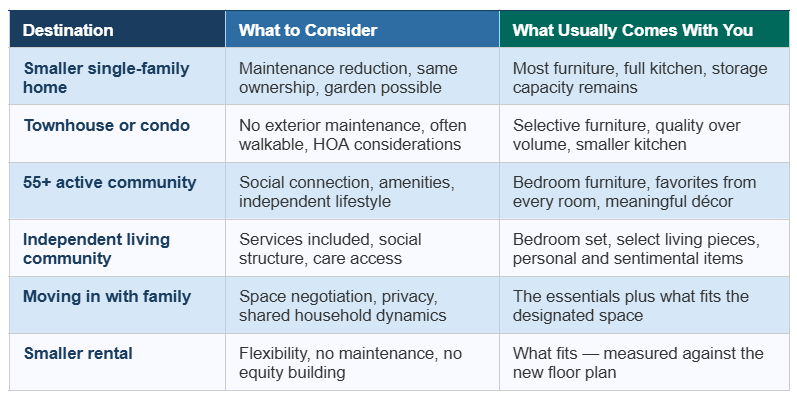
Step 2: Right-Size Before You Pack, Not After
The most expensive downsizing mistake is moving everything into a smaller home and then trying to figure out what does not fit: This produces a smaller home that feels as crowded as the larger one — because it is.
Right-sizing the contents of the home happens before moving day, not on it. Here is the professional sequence:
Start with a floor plan for the new space
Measure every room, every doorway, and every storage area in the destination before sorting begins. Knowing exactly what fits — in terms of both dimensions and volume — makes every subsequent decision clearer.
Place furniture on paper before moving it in reality
Create a scaled floor plan and place scaled furniture cutouts before committing to what comes. A dining table that worked in a 14×16 dining room may not fit in a 10×12 one. Find this out before the truck arrives.
Sort by room, category, and frequency of use
Work through every room systematically. For each item ask: do I use this regularly? Does it bring genuine value to my daily life? Does it fit the new space? Items that fail all three questions are candidates for gifting, donating, or selling.
Distribute family items before the move
Heirlooms, sentimental items, and belongings intended for family members should be claimed and removed before sorting begins in earnest. This prevents the decision about grandmother’s China from becoming a last-minute crisis.
Sell, donate, and discard with intention
Assign a route for each category of outgoing item before the sorting begins: estate sale, consignment, donation organization, junk removal. Items with a designated destination leave faster than items in a holding pattern.
THE FLOOR PLAN RULE: Nothing should be committed to the moving truck until it has been placed on a scaled floor plan of the new home and confirmed to fit — dimensionally and visually. A scaled floor plan session before sorting begins eliminates the most common and most painful downsizing regret: moving furniture that does not work in the new space and living with it anyway.
Step 3: The Right-Sizing Framework for What to Keep
When every item in a home is a candidate for either coming or going, decisions become paralyzing without a clear framework. Here is the professional right-sizing framework:
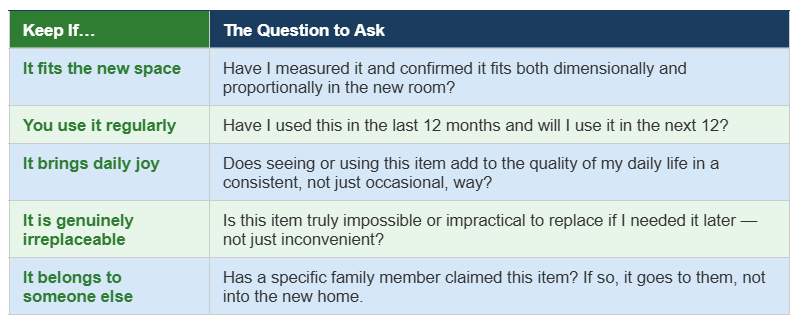
THE HARDEST CATEGORY: Sentimental items are the hardest decisions in any downsizing process — not because they are not worth keeping, but because they compete for limited space with everything else. The professional approach: sentimental items that are displayed, used, or genuinely treasured daily earn their place. Sentimental items stored in boxes that are never opened to not serve their purpose in any home. The right home for those items may be with a family member who will display them, a digitized format (for photos and documents), or a thoughtful donation to an organization that will use them.
Step 4: Set Up the New Home With Intention
Arriving at a right-sized home is not the end of the process — it is the beginning of a new one. How the new space is set up in the first days determines how it will feel for years.
Use the floor plan created before the move to direct placement on moving day. Every piece should have a confirmed destination before the truck arrives.
Set up the bedroom and bathroom first. Sleep and daily hygiene anchor everything else. A household that rests well the first night settles into a new home faster.
Give the kitchen one week before fully organizing it. Spend that week using the space as it is and noticing where friction occurs. Organize the kitchen around how you actually use it in this specific space, not how you used the previous one.
Resist the urge to fill the new space. Right-sized homes often have less furniture than the previous home — and that is appropriate. Open space in a smaller home is not empty. It is breathing room. Give it time before filling it.
Evaluate what is not working after 30 days. After a month of living in the new space, the systems that need adjustment are apparent. Address them then rather than immediately — when you have real information about how the space is being used.
FOR RICHMOND & DC CLIENTS: Home to Home Services works with clients downsizing throughout the Richmond, VA area — including Henrico County, Chesterfield, and the West End — and the Washington, DC area, including Capitol Hill, Northwest DC, and surrounding communities. Whether you are moving from a four-bedroom colonial in Henrico to a condo in Short Pump, or from a Capitol Hill rowhouse to a senior community in Maryland, the right-sizing process is the same. The destination is different. The principles are not.
The Most Common Downsizing Mistakes
These are the patterns that consistently produce downsizing regret — and how to avoid them:
Moving everything and sorting at the destination. Moving is expensive. Paying to move items that will not fit or will not be used in the new home is avoidable waste. Sort first, move second.
Rushing the sorting process under deadline pressure. Decisions made in exhaustion or urgency are the ones most often regretted. Build the timeline to allow sorting to happen at a pace that produces good decisions, not fast ones.
Keeping duplicates. Two sets of dishes, three sets of bed linens for guest rooms you no longer have, kitchen appliances for entertaining at a scale the new home cannot accommodate. Right-sizing means matching what you keep to how you actually live now.
Failing to distribute family items before sorting. Waiting until after sorting to ask family members what they want almost always results in conflict, regret, and items leaving the home without reaching the right person.
Underestimating the emotional weight of the process. Downsizing is not just logistical. It is a process of letting go — of space, of accumulated objects, and of a version of life that the objects represented. Building in time for that emotional dimension is not optional. It is what makes the process sustainable.
Ready to start your right-sizing process?
Home to Home Services provides full move management and right-sizing support for homeowners throughout Richmond, VA and Washington, DC. From the first floor plan to the last box unpacked, we manage every aspect of the process so you arrive at your new home settled, not depleted.
Contact us today to schedule a free consultation.
Call or text: 804-496-1767
About Home to Home Services
Home to Home Services is a full-service home transition company specializing in packing & unpacking, move management, home organizing, and design & space planning. We serve homeowners, families, and seniors throughout Richmond, VA, Washington, DC, and surrounding areas.
