
Eco-Friendly Packing: Why We Use Recycled Materials and How It Saves You Money

Most professional packing services operate on a simple model: purchase new boxes and materials for each client, pack the home, and leave the client to deal with the cardboard afterward. The boxes get broken down and recycled or, more often, left on the curb or in a garage when they sit for weeks until someone gets around to them.
At Home to Home Services, we approach materials differently — and the difference is good for the environment, good for our clients’ budgets, and good for the communities we work in.
OUR MATERIALS PHILOSOPHY: A box that has done one move has the structural integrity to do another. Packing paper that has cushioned dishes once can cushion them again. Bubble wrap does not stop working after a single use. We build our packing materials practice around this simple truth: reuse what is sound, supplement with new only what needs to be new, and reduce the waste that the moving industry generates by default.
How Our Materials Loop Works
The system is straightforward. When we complete an unpacking engagement — setting up a client’s new home, emptying boxes, and getting every room functional — we do not simply leave the used materials behind. We assess them.
Boxes that are structurally sound, without damage to their walls, corners, or seams, are broken down, organized by size, and stored for use in a future packing engagement. Packing paper that is intact and clean is refolded and stored.
When we pack a future client’s home, these collected materials are used first. New materials are purchased to supplement where the reused supply does not cover the scope — but the starting point is always what has already served one move well and can serve another.
Step 1 — Unpack a client’s new home
Boxes, paper, and materials accumulated after unpacking
Step 2 — Assess and collect sound materials
Structurally sound boxes sorted by size and stored
Step 3 — Use collected materials to pack the next client
Reused materials reduce new purchase cost — savings passed to client
WHAT WE KEEP VS. WHAT WE DON’T USE: Not all used materials are suitable for reuse. We assess every box before storing it: corners intact, walls without water damage or significant compression, seams sound. Paper that has been torn, wet, or badly compressed is recycled rather than reused. The standard for reused materials is the same as for new: everything we use to pack a client’s belongings must be structurally appropriate for the job.
How It Saves You Money
Moving supplies are a meaningful cost in any professional packing engagement. A typical three-bedroom home packing project requires 40-60 boxes in various sizes, multiple rolls of packing paper, bubble wrap, and tape — materials that add $150-350 to the cost of a new-materials packing job.
When reused materials cover a significant portion of that volume, the cost of materials decreases — and we pass that reduction on to the client. The savings vary by the volume of available reused supply and the scope of the pack, but clients whose moves are sourced substantially from our reused materials inventory consistently pay less for materials than they would in an all-new materials engagement.
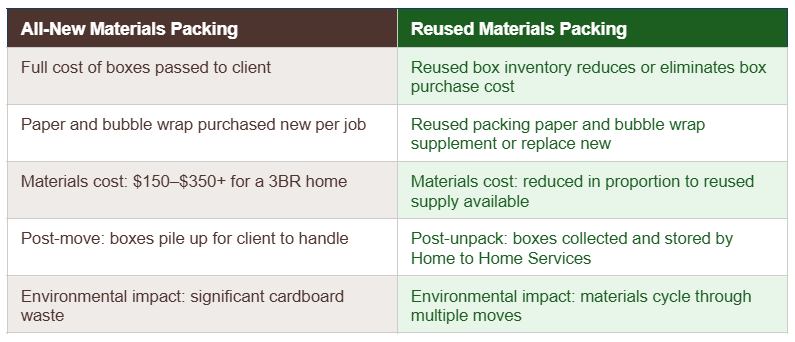
THE REAL COST OF PACKING MATERIALS: Most clients are surprised by how much packing materials cost when itemized separately. A bundle of 25 large boxes runs $40-60 new. A 200-sheet newsprint paper pack runs $30-40. Across a full home pack, materials alone often represent 15-25% of the total project cost. Every dollar of reused materials that replaces a new purchase is a dollar that stays in the client’s pocket.
The Environmental Case
The moving industry generates a significant amount of cardboard waste. The average American move produces 30-60 cubic feet of discarded packing materials — boxes, paper, bubble wrap, foam peanuts — the majority of which ends up in landfills, or, at best, in single-use recycling streams that require significant energy to process.
Reuse is more environmentally efficient than recycling. A box that makes two or three moves before retirement consumes zero additional resources beyond the original production. A box that is recycled after one move requires energy for collection, processing, and manufacturing of new material — a fraction of virgin production, but still a cost.
Every reused box is one fewer box manufactured, shipped, and processed after a single use.
Every sheet of reused packing paper is one fewer sheet of virgin or recycled paper produced for a single application.
Every retained roll of bubble wrap is plastic that makes multiple trips instead of one.
The aggregate impact across dozens of moves per year is meaningful: tons of cardboard and plastic diverted from single-use cycles.
OUR COMMITMENT TO THIS COMMUNITY: We work in Richmond and Washington, DC — communities with strong environmental values and a genuine commitment to sustainability. Our materials reuse practice is not a marketing position. It is a reflection of those values applies to the practical reality of the moving industry. We want the work we do to leave less behind — less waste in landfills, less burden on clients’ budgets, and less of the throwaway culture that the moving industry has normalized.
What This Means for You as a Client
If you are booking a packing engagement with Home to Home Services, here is what the reused materials practice means for your specific experience:
Your packing quote will reflect the available reused materials inventory at the time of your engagement. If we have a strong supply of your needed box sizes, materials costs in your quote are lower than they would be for a new-materials job.
The boxes used to pack your home have been assessed for structural integrity before use. They are sound. A box’s previous use does not affect its ability to protect your belongings in transport when it is in good condition.
After your unpacking session, the materials from your move enter the same cycle. Your boxes and paper become someone else’s next move — and the community benefit continues.
If you have boxes from a previous move, a recent delivery, or another source that you would like us to assess for use in your packing, we welcome that conversation. Client-supplied materials that meet our standards can be incorporated into your pack.
If specific items require new specialty materials — mirror boxes, wardrobe boxes, specialty paper — those are purchased new and itemized in your quote. We do not compromise protection for the sake of reuse.
THE COMMUNITY DIMENSION: One of the things we value most about this practice is what it represents in our community: a Richmond or DC family’s move directly supports the next family’s move through the materials they leave behind. The boxes that carried a Henrico County family’s books become the boxes that carry a Capitol Hill family’s kitchen. Nothing is wasted. Everything continues.
Eco-friendly packing is not a compromise. It is a better version of the same service — better for the environment, better for the budget, and better for the communities we are fortunate to work in every day.
Book an eco-friendly packing service in Richmond or DC.
Home to Home Services provides professional packing and unpacking throughout Richmond, VA and Washington, DC. Our reused materials practice reduces your materials cost, supports the environment, and keeps our community’s resources in circulation.
Contact us today to discuss your move.
Call or text: 804-496-1767
About Home to Home Services
Home to Home Services is a full-service home transition company specializing in packing & unpacking, move management, home organizing, and design & space planning. We serve homeowners, families, and seniors throughout Richmond, VA, Washington, DC, and surrounding areas.
